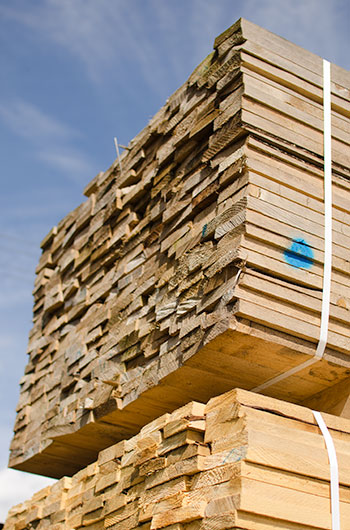
Calculation of sawn timber volume
Sawn timber (sawn wood, construction timber, beams, boards, planks, battens) is one of the basic materials in woodworking, joinery, carpentry, furniture making and construction. Unlike logs, sawn timber has a precisely defined geometric shape, which makes it possible to carry out an accurate calculation of sawn timber volume, also known as timber scaling. In this guide, you will learn how sawn timber volume is calculated in m3, how sawn-wood measurement works in Europe and in the USA/Canada, what units are used, which sizes are common in practice and how to avoid the most common mistakes when measuring.
This article is intended for sawmills, joiners, carpenters, timber merchants, construction companies, furniture manufacturers and anyone who needs to quickly and accurately determine the volume of boards, beams, planks or battens.
Why an accurate calculation of sawn timber volume matters
An accurate calculation of sawn timber volume is crucial for buying and selling timber, invoicing, pricing, delivery checks, stock control, logistics, production planning and international trade. For larger quantities, even a small mistake in dimensions or piece count can mean a significant difference in total volume and price.
Correct timber scaling is also important when comparing supplier offers, calculating the price per m3, planning material consumption on site and keeping inventory records.
What sawn timber volume is
Sawn timber volume expresses how much space a particular piece or quantity of sawn wood occupies. It is most commonly stated in cubic metres (m3), or in North America in board feet (BF). For sawn timber, volume is calculated geometrically from length, width and thickness.
The basic principle of calculating sawn timber volume
Sawn timber volume is calculated from the dimensions of each piece. This applies to boards, beams, planks, battens and other cross-sections.
Basic formula for calculating sawn timber volume (metric system)
If the dimensions are given in millimetres, they must be converted to metres before calculating.
Example: calculating the volume of a board
A board has the dimensions: length 4.0 m, width 200 mm, thickness 50 mm.
After conversion: 200 mm = 0.20 m, 50 mm = 0.05 m
Volume = 4.0 × 0.20 × 0.05 = 0.040 m3
Quick formula when dimensions are in millimetres
If you have thickness and width in millimetres and length in metres, you can also use this practical formula:
Example:
50 × 200 × 4 / 1 000 000 = 0.040 m3
Calculating the volume of multiple pieces of sawn timber
For larger quantities, the most common approach is to calculate the volume of one piece and then multiply by the number of pieces. If a delivery includes different cross-sections or different lengths, volume is calculated by line item and then summed.
Formula for multiple pieces
Example: calculating the volume of beams
50 pieces of beams 100 × 100 mm, length 6 m
Volume of one piece: 0.10 × 0.10 × 6 = 0.06 m3
Total volume: 50 × 0.06 = 3.0 m3
Example with different line items
If you have:
- 20 boards 25 × 150 × 4 m
- 12 beams 100 × 100 × 5 m
- 30 battens 30 × 50 × 3 m
Each line item is calculated separately and the results are then summed. This approach is the most accurate for warehouse issue slips, quotations and goods-in checks.
Units used for calculating sawn timber volume
Europe and most of the world
In Europe, the cubic metre (m3) is the standard base unit of volume. Thickness and width are typically stated in millimetres (mm) and length in metres (m). This system is compatible with technical and commercial practice in the timber industry.
In international trade, besides m3, piece count, bundles, pallets, quality grade, strength class, wood species and moisture content are often used.
USA and Canada
In the USA and Canada, sawn timber is very often traded in board feet (BF), especially for hardwoods and part of sawmill production. For construction lumber, nominal sizes are also used, which often differ from the actual sizes after drying and machining.
Calculating sawn timber volume in the USA and Canada: board foot
What a board foot is
1 board foot is the volume of a board 1 inch thick, 12 inches wide and 12 inches long. That is a volume of 144 cubic inches.
Board-feet formula
Example calculation in board feet
A board with dimensions 2 in × 8 in × 10 ft:
BF = (2 × 8 × 10) / 12 = 13.33 BF
Conversions between BF and m3
- 1 board foot ≈ 0.0023597 m3
- 1 m3 ≈ 423.78 board feet
With North American lumber, it is always important to distinguish between nominal size (e.g., 2 × 4) and the actual size after machining.
Nominal vs actual lumber sizes
One of the most common mistakes in timber scaling is mixing up nominal and actual size. A manufacturer, merchant and customer may use the same size name, but physically the material may have a smaller cross-section after drying, planing or calibration.
Example:
- nominal 50 × 200 mm may be about 45 × 195 mm in practice,
- nominal 2 × 4 in often has an actual size of about 1.5 × 3.5 in in North America.
For an accurate calculation of sawn timber volume, it is therefore recommended to use actually measured dimensions, not only the trade designation.
Common sawn timber sizes in practice
Different countries have established size ranges that repeat in practice. They are not identical in every market or from every producer, but it makes sense to list them because people often search for terms such as standard sawn timber sizes, common beam sizes, board sizes or batten sizes.
Common board and plank sizes in the metric system
In European practice, you often encounter sizes such as:
- boards: 18 × 100 mm, 20 × 100 mm, 24 × 120 mm, 25 × 150 mm, 32 × 150 mm, 40 × 200 mm
- planks: 50 × 150 mm, 50 × 200 mm, 63 × 200 mm, 80 × 240 mm
- beams: 60 × 80 mm, 80 × 100 mm, 100 × 100 mm, 100 × 120 mm, 120 × 120 mm, 150 × 150 mm
- battens: 24 × 48 mm, 30 × 50 mm, 40 × 60 mm
For structural timber, strength-graded profiles such as C16 or C24 are often used, and final planed dimensions may be slightly smaller than nominal sizes.
Common timber lengths
Very common lengths range from 2.0 m to 6.0 m. In many product ranges, a 300 mm module is used, for example 2.4 m, 2.7 m, 3.0 m, 3.3 m, 3.6 m, 4.2 m, 4.8 m or 5.4 m.
Some producers also supply custom lengths, precisely cut lengths, or mixed-length bundles.
Common sizes in the USA and Canada
In North America, construction lumber is often labelled as:
- 1 × 4
- 2 × 4
- 2 × 6
- 2 × 8
- 2 × 10
- 2 × 12
- 4 × 4
- 6 × 6
These sizes are generally nominal, not actual. For volume calculation, it is therefore important to work with the real cross-section of the delivered material.
Calculating the volume of a bundle of sawn timber
In practice, not only a single piece is sold, but a whole bundle of sawn timber. The most accurate method is to calculate the volume of all pieces in the bundle based on the piece list. If the bundle has uniform piece dimensions and the same lengths, the calculation is simple:
If the bundle contains mixed lengths or different cross-sections, it is recommended to split it into separate line items. In trade it is important to distinguish between:
- net wood volume – the sum of the piece volumes,
- stack/bundle outer volume – the external dimensions of the bundle including gaps.
For pricing and invoicing, the net wood volume is usually used, not the outer outline of the bundle.
Wood moisture content and its effect on dimensions
Wood dimensions can change depending on moisture content. Fresh, kiln-dried and planed timber may not have the same dimensions. For technical specifications and standards, it is therefore often stated whether the dimensions are nominal, target or actually measured.
If you need an accurate volume calculation for trade, production or claims, it is useful to verify:
- whether the timber is fresh or dried,
- whether the timber is rough-sawn or planed,
- at what moisture content the dimensions were declared.
Accuracy, tolerances and standards
Professional measurement of sawn timber takes into account manufacturing tolerances, machining method, wood moisture, quality grade and standardised dimensions. In Europe, structural timber often follows standards for dimensional deviations and strength grading. In practice, this means the trade-designated size may not be identical to the actually measured size of every piece.
Notice: Specific tolerances and rules can vary by country, timber type, standard, producer and degree of machining. For technically or contract-sensitive deliveries, it is advisable to verify the exact requirements in the technical documentation.
The most common mistakes when calculating sawn timber volume
- mixing up millimetres and metres in calculations,
- using nominal sizes instead of actual sizes,
- incorrectly counting the number of pieces,
- rounding each piece instead of rounding only the final total,
- mixing different lengths and cross-sections in one calculation without splitting into line items,
- confusing net wood volume with the outer bundle volume.
If you want accurate results, it is recommended to record each line item separately and also note the wood species, quality, moisture content and intended use.
Practical use: calculator, records and scaling logs for sawn timber
For a one-off calculation, a simple formula or an online sawn-timber volume calculator is enough. In professional operations, however, it is usually not enough to convert only m3. What also matters is record keeping for sawn-timber scaling, measurement history, printing outputs, assigning to a supplier or customer, stock movements and the ability to evaluate prices.
That is why mobile apps and record systems are used in practice, enabling you to:
- record individual pieces and complete line items of sawn timber,
- keep scaling records and stock movements,
- create outputs for trade, transport and internal records,
- work directly in the field even without internet access.
Fast measurement of sawn timber and wood volume using our apps
If you need not only to calculate volume but also to create systematic records, our apps are a suitable solution.
Recorder enables records of scaling for sawn timber and logs, item tracking, stock records, printing reports and offline work. It is suitable for companies that need to keep measurements, piece lists and commercial data connected to everyday practice in the warehouse, production or in the field. Complete information about this woodworking mobile app can be found here, or download it directly from Google Play.
For fast operational measurement, WoodProfi is also available – an intelligent tool for fast wood-volume measurement using photographs and smart timber measurement solutions. The app focuses on quick use for wood, logs, timber trucks and sawn timber. Thanks to that, it is suitable wherever speed, mobility and easy on-site use are decisive. Find more information at WoodProfi, and you can get it on Google Play.
Combining classic geometric calculation with digital tools significantly speeds up sawn-timber scaling, reduces errors and improves record keeping across the whole company.
When to use precise geometric calculation and when to use digital measurement
- Precise geometric calculation is ideal for pieces with known dimensions, invoicing, quotations and technical documentation.
- Record-keeping apps are suitable for repeated measurements, stock control, buying and selling, field work and a large number of line items.
- Measurement using photographs is practical for quick estimation, operational checks and situations where you need a result on the spot without lengthy manual recording.
Frequently asked questions about sawn timber volume
How many m3 does a board have?
It depends on its length, width and thickness. The volume is calculated using the formula: length × width × thickness.
How do you calculate cubic metres of sawn timber from millimetres?
Use the formula: thickness (mm) × width (mm) × length (m) / 1 000 000.
Do you calculate using nominal size or actual size?
For an accurate volume calculation, it is recommended to use the actual size, i.e., the truly measured cross-section and length.
What are common sawn timber lengths?
Very common lengths are 2.4 m, 3.0 m, 3.6 m, 4.2 m, 4.8 m, 5.4 m and 6.0 m, but the exact range depends on the market and producer.
What is the difference between m3 and board foot?
m3 is the metric unit of volume used in Europe and in much of the world. Board foot is a North American unit of volume used mainly for sawn timber and hardwood.
Summary
Calculating sawn timber volume is straightforward for boards, beams, planks and battens if you know the right dimensions and use the correct units. The key is to distinguish between nominal and actual size, convert mm to metres correctly, and for larger quantities calculate by line item.
If you only need a quick calculation, a formula or a volume calculator is enough. If you deal with regular measurements, trade records, stock or field scaling, it pays to use digital tools for records of scaling and for fast wood measurement using photographs.